
Selling in Florida
How to Sell a House Without a Realtor in Florida (2026 Guide)
In 2026, just 7% of Florida sellers skip a realtor. Learn what FSBO actually costs in Florida and how a direct cash sale compares.
Deciding how to sell your property in Florida often comes down to a choice between maximizing your final profit or minimizing your total stress. Many homeowners start this journey by researching how to avoid agent fees, looking for a way to keep more of their hard-earned equity. You generally have two distinct paths when you choose to sell without a traditional listing: managing a public sale yourself or selling directly to a professional buyer.
This guide walks through the specific steps, legal requirements, and actual costs involved in selling a house without a realtor in Florida. From the impact of recent industry settlements to the mandatory disclosure statutes, we will cover what you need to know to make an informed decision for your home.
What “Selling Without a Realtor” Actually Means in Florida
In the Florida market, avoiding a traditional agent listing usually leads a homeowner toward one of two very different processes. The first is For Sale By Owner, commonly known as FSBO. In this scenario, the owner takes on the role of the listing agent. This includes marketing the home, coordinating every showing, and navigating the legal paperwork through owner-listing channels or a flat-fee MLS service.
The second path is a direct sale to a cash buyer. In this model, you sell the property directly to an entity like Merit Closings Home Buyers without ever listing the home on the public market. This approach eliminates the need for open houses and public marketing entirely. When you choose a direct sale, you are dealing with a single buyer who has the funds ready to close, rather than trying to attract a retail buyer through traditional advertising. You can learn more about how a direct cash sale functions by reviewing Merit’s three-step process.
The popularity of these methods varies significantly. In 2023, data from Florida Realtors showed that 89% of sellers still used a traditional agent, while only 7% chose the FSBO path. Less than 1% of Florida sellers used an iBuyer platform during that same period. However, the cash buyer market is much broader than these numbers suggest. While FSBO and agent listings describe how a home is sold, “cash” describes how the buyer pays. Roughly 34% of all Florida residential closings in 2024 and 2025 were cash transactions. This volume includes retirees, international investors, and direct cash buyers like Merit Closings.
How the August 2024 NAR Settlement Changed the Math
The landscape for selling a home in Florida changed fundamentally on August 17, 2024. On this date, new rules from the National Association of Realtors settlement took effect, changing how commissions are handled. Previously, a listing agent would display the offer of compensation for a buyer’s agent directly on the Multiple Listing Service. Under the new rules, these offers of compensation have been removed from MLS fields.
For FSBO sellers, this means that any negotiation regarding agent fees now happens entirely off the MLS. Furthermore, buyers working with an agent who participates in the MLS now generally need to sign a written buyer agreement before they can even tour a home. While some predicted this would lead to sellers no longer paying for the buyer’s agent, the practical reality in Florida has been different. A 2025 HomeLight survey found that 92% of Florida respondents reported that sellers were still covering buyer-agent compensation to stay competitive.
The demand for clear documentation of these fees remains high. Florida Realtors originally created separate buyer-broker compensation forms in the summer of 2024 but replaced them with a combined seller and seller-broker compensation form in January 2026. This change was made due to “greater demand” for a streamlined way to handle these off-MLS negotiations. The plain-language takeaway for a Florida homeowner is simple: the negotiation for the 5.57% average total commission moved off the MLS, not out of the deal. You can find a deeper breakdown of these figures in our guide to Florida home seller closing costs.
What FSBO Actually Looks Like in Florida (Step by Step)
Pricing the home
Pricing is the most critical hurdle for any FSBO seller. Without an agent to provide a Comparative Market Analysis, most Florida owners rely on professional appraisals or online data. Research indicates that 40% of FSBO sellers use a formal appraisal to set their price, while 36% rely on recent comparable sales in their immediate neighborhood. Setting the price too high can lead to the property sitting on the market for months, while pricing too low leaves money on the table.
Marketing and reaching buyers
Marketing a home involves more than just putting a sign in the yard. While 86% of agent listings utilize the MLS, and 61% use yard signs, the digital reach is where most buyers are found. About 49% of buyers find homes on Realtor.com and 47% use other third-party aggregators. Interestingly, 63% of FSBO sellers do not actively market their homes, often relying on word of mouth. Those who want open-market exposure often pay for flat-fee MLS providers. In Florida, these services typically range from $99 to $895 depending on the level of support and number of photos provided.
Required disclosures (Florida specifics)
Florida law is strict regarding what a seller must tell a buyer. Even without an agent, you are legally responsible for providing a specific stack of disclosures:
- Material defects: Under the Johnson v. Davis common-law rule, you must disclose any known facts that materially affect the value of the property and are not readily observable by the buyer.
- Lead-based paint: This is a federal requirement for any home built before 1978.
- HOA disclosure: Per Florida Statute section 720.401, sellers must provide a disclosure summary to buyers if the home is in a community with a homeowners association.
- Condo and co-op disclosures: Specific documents regarding the association’s financial health and rules are required for these property types.
- Flood insurance disclosure: Sellers must notify buyers about the flood risk and insurance requirements for the property.
- Property tax disclosure: Under Florida Statute section 689.261, sellers must provide a notice regarding the “Save Our Homes” cap and how property taxes may change after the sale.
- Building code violations: Per Florida Statute section 125.69, you must disclose any active building code violations to the buyer.
The contract (FAR/BAR)
Florida real estate transactions primarily use the FAR/BAR contract ecosystem, which is a set of standardized forms developed by Florida Realtors and The Florida Bar. These forms cover everything from the purchase price to the “As Is” condition of the property. Most FSBO sellers do not draft these from scratch. Instead, they typically access them through a real estate attorney or the title company they have chosen to handle the closing.
Inspection and renegotiation
Once a contract is signed, the buyer typically has a 7 to 21 day inspection period. This is a common point of failure for FSBO sales. If the buyer’s inspector finds issues with the roof, plumbing, or electrical systems, the buyer may attempt to renegotiate the price or cancel the contract entirely. Without an agent to manage these negotiations, the seller must handle these high-pressure conversations directly with the buyer or the buyer’s agent.
Closing process
Florida is a title-company and closing-agent state. There is no statewide rule requiring an attorney to be present at a residential closing, although some sellers choose to hire one for peace of mind. The closing agent is responsible for performing the title search, disbursing all funds, recording the deed with the county, and ensuring all existing mortgages or liens are paid off. Understanding the total cost of this process is essential before you sign a contract.
The Real Costs of FSBO in Florida
To understand the math of a FSBO sale, it helps to use the median Florida home price of $420,000 as a benchmark. Many homeowners assume that selling without an agent saves them the entire commission, but that is rarely the case in practice.
The primary cost a FSBO seller avoids is the listing-side agent commission, which averages about 2.75% or $11,550 on a median-priced home. However, there are several costs that a FSBO seller generally does not avoid:
- Buyer-agent commission: Because 92% of Florida sellers still cover this fee to attract buyers, you can expect to pay roughly 2.82% or $11,844.
- Documentary stamp tax: This is a state-mandated transfer tax of 0.70% of the sale price, which totals $2,940 on a $420,000 sale.
- Title insurance and settlement fees: These costs typically run about 0.52% or $2,184.
- HOA estoppel: If applicable, this is capped at $299 for a standard request.
- Property tax proration: You will owe the buyer a credit for the portion of the year you lived in the home.
- Mortgage payoff recording: A small administrative fee of $10 to $20.
When you add these up, the total transaction cost for a FSBO sale in Florida is roughly 6.08% or $25,536. While this is a net savings of approximately $11,550 compared to a traditional agent listing, it is far from “cost free.”
There are also significant risks to consider. According to 2024 NAR data, 17% of FSBO sellers struggle with pricing the home correctly, and 13% struggle to sell within their planned timeline. Another 10% find the paperwork overwhelming. Perhaps most tellingly, about 1 in 5 FSBO sellers eventually give up and hire a professional agent to finish the job. It is also worth noting that 38% of FSBO sales nationally are “pre-matched” deals to a relative, friend, or neighbor, rather than open-market sales.
While FSBO can save you the listing commission, it typically does not save the full 5.57% commission homeowners expect. The savings come with a significant increase in workload and legal risk. Before you decide to handle the marketing yourself, you should have a clear understanding of how much your house is worth in Florida to ensure your pricing strategy is sound.
Comparing All Three Paths
| Dimension | Traditional Agent | FSBO | Direct Cash Sale (Merit) |
|---|---|---|---|
| Time to close | Roughly 94 days (Florida 2025 median) | Variable; often longer than agent due to marketing | 13 days (Merit average) |
| Marketing burden | Agent handles | You handle | None |
| Paperwork burden | Agent handles | You handle | Closing agent handles |
| Buyer-side commission | Yes (roughly 2.82%) | Often yes (92% of FL FSBO sellers pay) | None |
| Closing costs | Yes (roughly 3.26%) | Yes (roughly 3.26%) | Paid by Merit |
| Total seller cost | Roughly 8.83% or $37,090 | Roughly 6.08% or $25,536 | $0 |
| Fall-through risk | Financing, appraisal, inspection | Same plus buyer-found risk | Lowest (no financing contingency) |
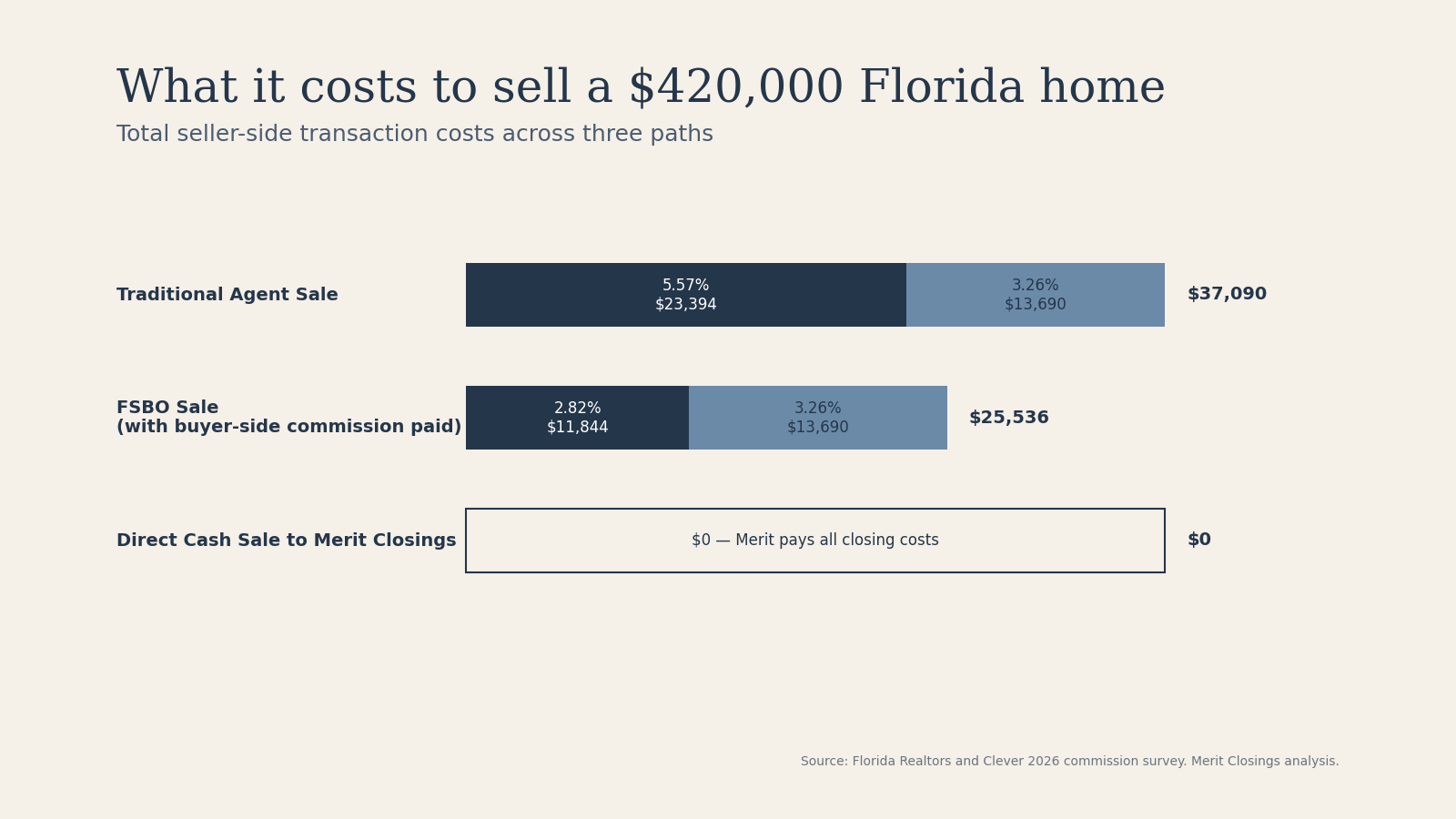
While FSBO does save money, most of those savings come from skipping the listing-side commission only. The buyer-side commission, state taxes, and closing fees remain your responsibility. You also retain the full burden of marketing and paperwork. A direct cash sale is a structurally different path that focuses on speed and the total elimination of transaction costs for the seller.
Selling Directly to Merit Closings
On a $420,000 Florida home, traditional sales cost the seller about $37,090 in transaction fees. FSBO can save the listing-side commission but typically still costs about $25,536. Selling directly to Merit Closings Home Buyers eliminates seller-side transaction costs entirely.
Our model is designed for homeowners who want to bypass the uncertainty of the retail market. We pay every closing cost, including settlement fees, recording fees, and Florida documentary stamp taxes. Because there is no agent involved on either side, there are no commissions to pay. We purchase properties directly from homeowners, so we do not act as a realtor when we purchase properties directly from homeowners.
The Merit Closings track record includes 73 homes closed in the last 12 months across Florida, with over $23 million in gross sales volume. Our process results in a 13-day average cash close. We provide a market-value cash offer that is not subject to bank financing contingencies or the need for repeated public walkthroughs.
It is important to be realistic about the trade-offs. A cash offer reflects a discount for the certainty and extreme speed we provide. You may be able to find a higher “sticker price” by listing the home for several months and paying for repairs and commissions, but the net amount in your pocket may not be as different as you expect. Existing obligations like your mortgage payoff, property liens, and back property taxes are still deducted from the proceeds at closing, but there are zero out-of-pocket costs to the seller.
Frequently Asked Questions
Do I have to use a realtor to sell my house in Florida?
No. Florida law does not require a real estate agent to sell residential property. Owners have the legal right to list FSBO, sell directly to a cash buyer, or work with a traditional agent. Each path offers a different balance of costs, workload, and closing timelines.
Can I sell my house in Florida without paying any commission?
It depends on the path you choose. FSBO sellers can avoid the listing-side commission (about 2.75%), but 92% of Florida FSBO sellers still end up covering the buyer-agent commission (about 2.82%) to attract represented buyers. Direct cash sales to a buyer like Merit Closings involve no agents on either side, which means there is no commission to pay.
What disclosures do I have to give the buyer if I sell FSBO in Florida?
Florida sellers must disclose known material defects that are not readily observable to the buyer under the Johnson v. Davis rule. You may also be required to provide a lead-based paint disclosure, an HOA disclosure (Florida Statute section 720.401), condo or co-op disclosures, flood insurance notices, property tax disclosures (Florida Statute section 689.261), and building code violation notices (Florida Statute section 125.69).
Do I need an attorney to close on a FSBO sale in Florida?
Florida does not require a real estate attorney for residential closings. Most transactions in the state are handled by a title company or closing agent who manages the funds and records the deed. Some FSBO sellers hire an attorney to review the contract or help with complex issues like heirship or existing liens. For broader seller questions, review the Merit Closings FAQ page.
How does selling to a cash buyer compare to FSBO?
FSBO requires you to manage every aspect of the sale, from pricing and marketing to showings and legal paperwork, and you will likely still pay a buyer-agent commission. A direct cash sale to a buyer like Merit Closings removes that workload entirely. While a cash offer may be lower than a perfect open-market price, you pay $0 in closing costs and avoid the risk of a buyer’s financing falling through.
Sources
- Florida Realtors, 2023 Florida Profile of Home Buyers and Sellers
- National Association of Realtors, 2024 and 2025 Profile of Home Buyers and Sellers
- Florida Realtors, Year-End 2024 and 2025 Florida Single-Family Homes Data
- Florida Realtors, Year-End 2024 and 2025 Florida Townhouses and Condos Data
- National Association of Realtors, August 17 2024 Practice Change Implementation
- Florida Realtors, NAR Settlement: Buyer Broker Agreements FAQ
- Florida Realtors, 2024-2026 Buyer-Broker Compensation Forms Updates
- HomeLight, Who Pays Realtor Fees in Florida (2025 Survey)
- Clever Real Estate, Average Real Estate Commission in Florida (2026 Survey)
- Florida Bar Journal, Johnson v. Davis Material Defect Disclosure
- Florida Statutes Chapters 720, 689, 125 (referenced sections)
- #FSBO
- #selling without realtor
- #Florida real estate
- #cash buyer